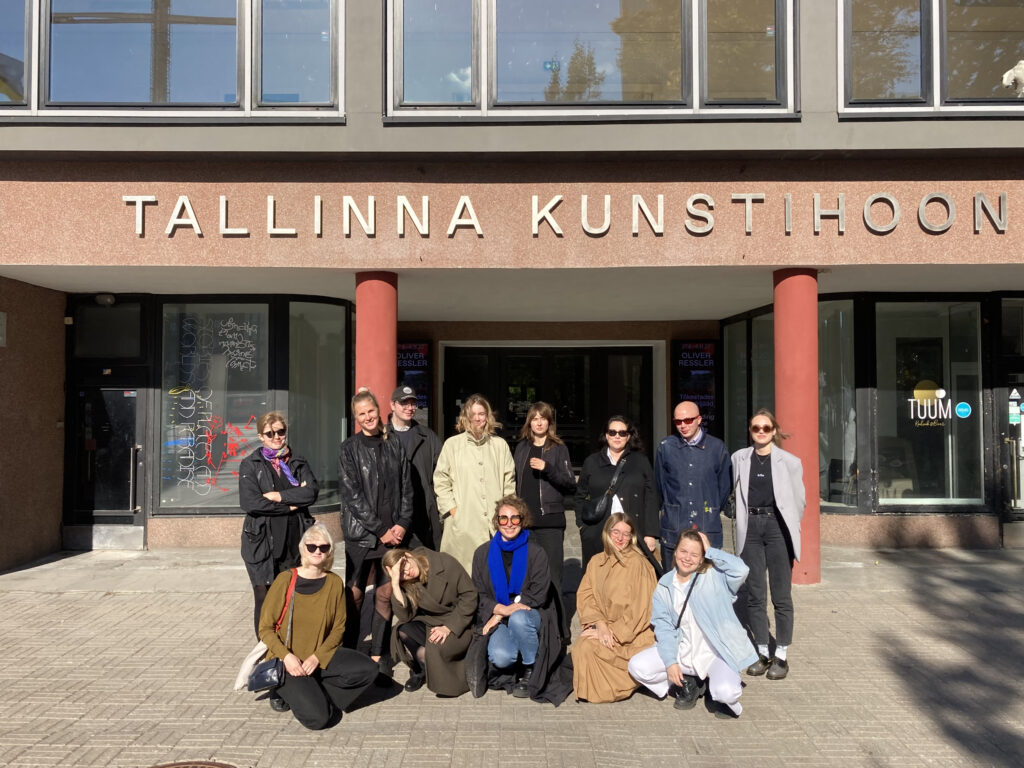
This week a group of Icelandic and Lithuanian curators, art critics, producers and artists are visiting Tallinn for a research and networking trip. The research is part of the Borderland Poetics network. The group is hosted by the Estonian Centre for Contemporary Art.
The participants of the research trip are:
Helena Aðalsteinsdóttir is an artist and curator who lives and works between Reykjavik and London. Helena’s interest in cross-disciplinary art practices and inclusive public programming informs their curatorial practice, along with their fascination with science fiction and performance. Helena directs a collaborative artist residency Laumulistasamsteypan and GSM exhibition space, and works as curatorial assistant at Southbank Centre in London.
Sunna Ástþórsdóttir is a curator, writer and editor, currently the director of The Living Art Museum, Reykjavík, and co-owner of the Iceland-Danish-Norwegian based studio PSSÁ service. Sunna has initiated, curated and led projects and exhibitions in Iceland and Denmark, as well as written exposition texts and articles for various exhibition spaces and initiatives. Her recent projects include: outdoor exhibition The Wheel — Within Reach (2021, curator, Reykjavik Sculpture Association), Never the End, MA Fine Art Degree Exhibition at The Living Art Museum (2021, curator, Iceland University of the Arts), and Art in Iceland magazine (co-editor).
Kristín Dagmar Jóhannesdóttir is an independent curator, art critic and producer. Kristín Dagmar was director at Gerðarsafn – Kopavogur Art Museum from 2014 – 2019 and worked priorly at both Reykjavik Art Museum and The National Gallery of Iceland. She has an extensive experience in leading various curatorial projects. She was the artistic director at Sequences festival in 2009; co-founder of Cycle Music and Art Festival, 2015-2018; and recently managed Performance Nebula, festival at Reykjavik Art Museum in 2022. Kristin Dagmar is a frequent lecturer at Iceland University of the Arts and The Reykjavík School of Visual Arts.
Rugilė Miliukaite is an art historian and critic who works at the Rupert art center. While still exploring the subtleties of the contemporary art world, her field of interest is the sensory relationship between the artwork and its viewer. In 2021, she did a traineeship as part of the project Lithuanian Space Agency: Planet of People at the Lithuanian pavilion of the 17th International Architecture Exhibition – La Biennale di Venezia. During her studies, Rugilė obtained experience in several arts and cultural organisations such as (AV17) gallery, Rupert, Strategijos miestui, VMU Gallery 101, and Gallery Weekend Kaunas.
Audrius Pocius is a curator and a philosopher currently based in Vilnius. In his curatorial practices he is mainly focused on conceptual and performative aspects of art and their potency for social and cultural critique. Audrius has been a curator and educator at CAC Vilnius up until he co-founded Swallow space for contemporary art together with his co-conspirators. In 2022 he also founded Medūza – a space for contemporary art and culture operating under the umbrella of Lithuanian Artists’ Association. He is a junior researcher at Vilnius University and is lecturing courses on various topics related to philosophy, aesthetics and contemporary culture at Vilnius University, Vilnius Academy of Art and Lithuanian Academy of Music and Theatre.
Heiðar Kári Rannversson is an independent curator based in Copenhagen, Denmark and Reykjavik, Iceland. He was curator and head of exhibitions at North Atlantic House in Copenhagen from 2018 – 2022, and before that curator of public programs at the Reykjavik Art Museum. He has collaborated on numerous exhibition and research projects with different art institutions, held positions on several advisory boards in Iceland, and taught art history and art theory. He has written extensively on contemporary Icelandic art for scholarly journals, cultural magazines, catalogues, and books.
Þórhildur Tinna Sigurðardóttir is an independent curator, writer and project manager. She is the project manager of the Icelandic Pavilion at La Biennale Arte 2022, recently curated the public programming of LungA Art Festival and the summer programme for Gerðarsafn – Kopavogur Art Museum with Helena Adalsteinsdottir. She currently works for the Icelandic Art Center where she hosts a regular art podcast Out There with co-host Becky Forsythe. Tinna is the festival director of Sequences art biennial.
Viktorija Šiaulytė is curator and producer working in the fields of contemporary art, architecture and film. She has previously worked as independent curator and organizer for more than 10 years. Since 2020 she is co-founder and co-curator of Videograms, a festival for artists’ film and moving image in Vilnius, Lithuania. She collaborated with artists Nomeda and Gediminas Urbonas and writer Tracey Warr to curate Zooetics: Cross-disciplinary Approaches to Interspecies Ecology in Art, Science and Technology (2013–2018). She currently holds the post of research affiliate at the Massachusetts Institute of Technology (MIT) Program in Art, Culture and Technology, Cambridge/USA and has been a fellow at Akademie Schloss Solitude, Germany in 2020-2021.
Gabrielė Vasiliauskaitė is a communication specialist and performer. Vasiliauskaitė gained professional practice while working in the non-governmental sector, contributing to the implementation and development of such projects as the Ministry of Citizens and Coolūkis. She is currently working as a freelance communication specialist and is also actively involved in music.
The programme is coordinated by partners of the Borderland Poetics Research Programme – the Estonian Centre for Contemporary Art, The Icelandic Art Centre, Rupert – centre for arts, residencies and education. The Borderland Poetics is a 3-year long network to promote cooperation between Estonian, Icelandic and Lithuanian art scenes. The title is a reference to an exhibition “Border Poetics”, curated by Estonian curator Eha Komissarov in 2018.
The programme is supported by the Nordic Culture Point.