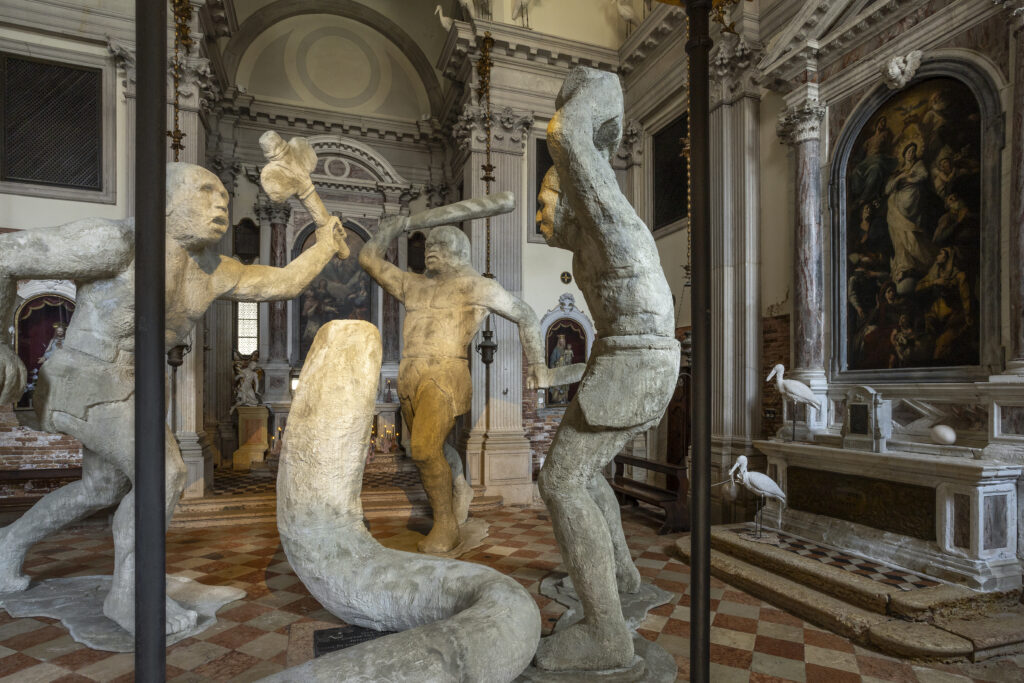
On 24 November, the 60th Venice Biennale concluded. This year, Estonia was represented by Edith Karlson’s exhibition Hora lupi. During the Biennale, the Estonian pavilion, located at the church of Santa Maria delle Penitenti in Cannaregio drew 24,000 visitors. From the very first day, Hora lupi was warmly welcomed by media with Artforum and Artsy including the exhibition in its lists of best national pavilions. To accompany the exhibition the catalogue Edith Karlson. Hora lupi was published together with Mousse Publishing. Preparations are underway to show the next chapters of Hora lupi both in Estonia as well as elsewhere in the Baltics.
The Estonian pavilion was extremely well received both by international art media as well as the general public. “Edith Karlson’s great dedication and works truly moved the audience, art professionals and other visitors gave a lot of positive feedback,” says Maria Arusoo, the commissioner of the Estonian pavilion. “Even as we are deinstalling the exhibition, we still receive messages from people who were touched by Hora lupi,” she adds. The exhibition was also included in the top pavilions lists by Artforum, Artsy and The Art Newspaper and several interviews with Edith Karlson were published in media outlets such as ArtReviews and Artribune.
Alongside the exhibition, a catalogue titled Edith Karlson. Hora lupi was published as well. The book features contributions by 16 artists and writers: Cecilia Alemani, Maria Arusoo, Bärbel Balodis, Eero Epner, Edith Karlson, Nikolai Karlson, Quinn Latimer, Emilia Palmipuu, Alana Proosa, Risto Pärna, Agne Raceviciute, Melany Raud, Dieter Roelstraete, Mona Lee Tšetõrkina, Anu Vahtra, Piero Vespignani. The visually rich publication brings together multifaceted texts from overviews of Karlson’s previous work, the history of the location of Hora lupi in Venice as well as more poetic approaches from writers of very different age. Edith Karlson. Hora lupi is published jointly by the Estonian Centre for Contemporary Art and Mousse Publishing.
After the closing of the pavilion, preparations to bring the next chapter of Hora lupi to audiences both in Estonia as well as elsewhere in the Baltic region are underway.
Edith Karlson is a sculptor who often presents her work as installation, using an entire exhibition space. Her works tackle the most inexplicable feelings and sensations in the current world: fear, melancholy, brutality and joy, which she transforms into material form, often in clay, concrete or found materials. Frequently working with animal forms and anthropomorphic figures, she approaches humans as animalistic beings whose impulses, wants, and desires are hidden just under the surface of their well-pressed suits. Karlson studied installation and sculpture at the Estonian Academy of Arts (BA, 2006; MA, 2008). She was awarded the EAA Young Artist’s Prize (2006) and Köler Prize People’s Choice Award (2015). Karlson is among the recipients of the national artists’ salary between 2018-2020 and 2022-2024 and was granted the Estonian Cultural Endowment’s main award (2020).
In 2013, the CCA in collaboration with universities and the Erasmus+ programme set up internship opportunity at the Estonian pavilion for students. Throughout the seven months, the pavilion was managed and introduced by students and volunteers: Lore Isabel Alender, Luukas Epner, Robin Kaiküll, Eva Karmen Kasemets, Irina Korzjukova, Kärt Laidma, Laura Martens, Mariia Metusalo, Eke Ao Nettan, Sarah Noonan, Aleksandra Nyysönen, Ulrika Paemurru, Aliisa Rantanen, Kerly Ritval, Ruuben Tootsen, Elo Vahtrik, Liisamari Viik.
Estonian exposition at the Venice Biennale is commissioned by Estonian Centre for Contemporary Art with the funding from the Estonian Ministry of Culture and since 2013, the Estonian pavilion is also supported by the law firm Cobalt. The 2024 Estonian pavilion was also supported by Postimehe Fond, Taavet+Sten Tulevikufond, Cobalt Law Firm, Cultural Endowment of Estonia, Enterprise Estonia, Tallinn City of Music, DSV Global Transport and Logistics, Põhjala Beer, Selver, Uus Rada Galerii, Tallinn Zoo, Estonian Museum of Natural History, Müürileht, Berengo, Estonian Academy of Arts, Pallas University of Applied Sciences.
Established in 1895, the Venice Biennale is the oldest and the most extensive international art forum in the world. Estonia has participated with a national pavilion since 1997.
The 60th Venice Biennale took place 20.04 – 24.11.2024.
Additional information:
Keiu Krikmann
Artist: Edith Karlson
Dramaturge: Eero Epner
Commissioner: Maria Arusoo
Architect: Piero Vespignani
Designers: Jojo & me
Head or Production: Sten Ojavee
Technical team: Tõnu Narro and Mihkel Lember (Technical Director), Johannes Säre (Dream Team)
Light designer: Oliver Kulpsoo
Sound designer: Raul Saaremets
Project coordinators: Mikk Lahesalu, Marika Agu
Project coordinator in Italy: Valeria Romagnini
Artist’s team: Art Allmägi, Sander Haugas, Kirsti Kaubi, Loora Kaubi, Ats Kruusing, Erik Liiv, Maria Luiga, Eva Mahhov, Liisi Põllumaa, Nikolai Saaremets, Hanna Samoson, Elo Vahtrik, artist’s dogs Iti and Kusti
Communication: Kaarin Kivirähk, Keiu Krikmann, Stina Pley, Alexia Menikou
Thank you: Katrin Kissa, Ene-Liis Semper, Raul Saaremets