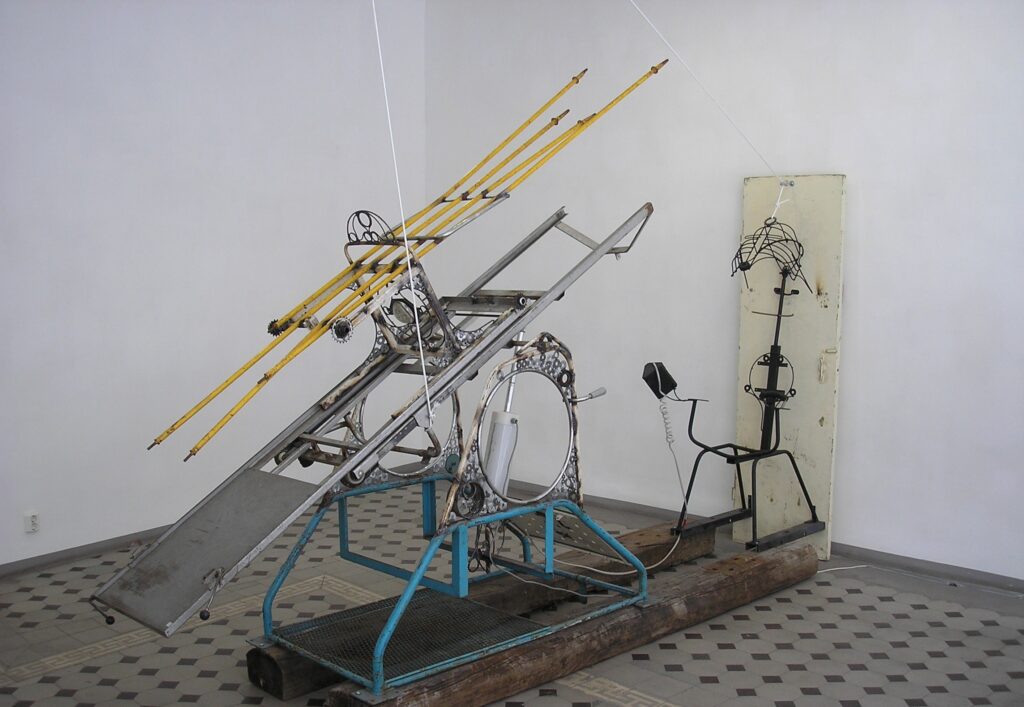
Erik Alalooga (b. 1974) is an Estonian visual and installation artist, sound artist, performer, educator, and cultural organiser. His interdisciplinary practice explores the relationship between humans and machines through kinetic sculpture, mechanical sound instruments, performance, and spatial installation. Working in deliberate opposition to narratives of technological efficiency and optimisation, Alalooga employs low-tech mechanical systems to create poetic, embodied, and participatory encounters in which sound, movement, and physical interaction become inseparable.A recurring theme throughout Alalooga’s work is the reversal of conventional power relations between humans and machines.
His early solo exhibition “Human and God” (2006) presented kinetic sculptures constructed from industrial remnants whose mechanisms remained inactive until touched by the viewer. Here, bodily intervention became the precondition for aesthetic experience, transforming the machine from a functional object into a mediator of human perception and agency. This performative understanding of sculpture has continued across Alalooga’s practice. In “A Cock-work Orange” (2017), presented in the Nortsu Road hangar in Rakvere, the machines could only be activated through an interaction with visitors. In “Singulator” (2018) at the Tartu Art Museum, the museum was reimagined as an immersive theatrical installation where audiences navigated hostile mechanical environments resembling an escape room. The exhibition drew upon the idea of technological singularity, imagining machines that had begun to operate beyond human control, while integrating kinetic sculpture, sound, interactivity, and scenography into a unified spatial experience.
Sound occupies an increasingly central position in Alalooga’s installations. “Liberated Machines” (2022), exhibited at the Monumental Gallery of the Tartu Art House, consisted of autonomous mechanical sound devices built from windscreen-wiper and disco-ball motors, wires, and salvaged metal. Connected to analogue pulse generators, the machines were released from their original utilitarian functions and transformed into continuously evolving sonic structures. Rather than controlling the machines, visitors were required to negotiate their unpredictable behaviour and become participants in an ever-changing mechanical concert.
The same principles informed “The Garden of Random Delights” (2023), a large-scale installation of seventeen motor-driven sound machines controlled by analogue random generators. The technical imprecision of the generators produced endlessly variable rhythmic and acoustic patterns, surrounding visitors with a pulsating circular sound environment in which mechanical noise and subtle electronic processing merged into a continuously shifting composition. In “Cabinet of Kinetic Curiosities” (2026), presented at ARS Project Space, Alalooga interpreted iconic figures from Western cultural history through seven autonomous kinetic sculptures inspired by Archimedes, Isaac Newton, Léon Foucault, Thomas Edison, Luis Buñuel, Marvin Minsky, and Nikita Khrushchev. The works functioned as artificial bodies whose choreographed mechanical gestures generated an independent spatial narrative, extending the artist’s ongoing exploration of intuitive machine-making beyond ideals of technological progress and precision.
Alongside his installation practice, Alalooga has maintained an active career as a sound performance artist. Performing both solo and collaboratively, he is a founding member of the experimental collective Postinstrumentum. His performances centre on self-built mechanical instruments and sound machines, employing electronics only minimally and privileging the direct physical manipulation of materials as the primary source of sound. His sound works have been released on cassette, including “Metronomic Nightmare “ (2018), “Voyeurism for Music” (2018), published alongside his monograph, “Ringhold” (2019, with eleOnora and Kalle Tikas), and “Post Humanist Hangover – Parabolic Dialogue” (2025).
Erik Alalooga graduated from the Estonian Academy of Arts with a BA in Sculpture (2002) and an MA in Interdisciplinary Arts (2004), and received a PhD in Theatre Arts from the Estonian Academy of Music and Theatre (2023). He taught at the Estonian Academy of Arts between 2006 and 2013, serving as Associate Professor in the Department of Interdisciplinary Arts and later as Head of the Chair of Performance Arts. In 2016 he founded Supersonicum, a gallery dedicated to performance art and experimental music in Viljandi. His work has been exhibited internationally throughout the Baltic and Nordic countries, as well as in Germany, Austria, France, Switzerland, the Czech Republic, the Netherlands, the United Kingdom, Italy, the United States, and Australia. In 2023 he received the Annual Prize of the Estonian Cultural Endowment’s Visual and Applied Arts Foundation, and from 2024 to 2026 he was a recipient of the Estonian state artist salary.